Snakes
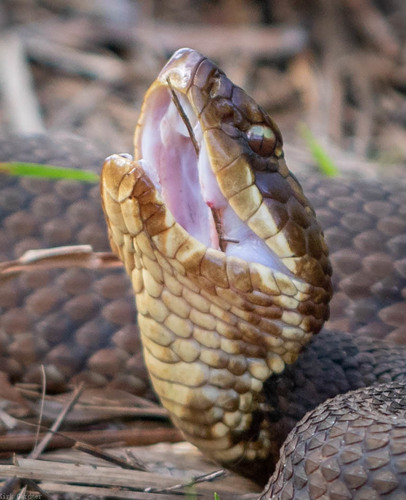
Northern Cottonmouth
Agkistrodon piscivorus
Across the regions where it's common, the Northern Cottonmouth peaks from March to October.
Shows up in 13 ecoregions and 14 states · venomous
Keep Herp Calendar free
Hi, I'm Nick. I built Herp Calendar on my own and I keep it free, with no ads. If it has helped you find a herp this season, a small tip goes straight into the hosting and the data work. Only if you can spare it. Either way, I'm glad you're here.
Snakes
Northern Cottonmouth
Agkistrodon piscivorus
Description
Agkistrodon piscivorus is a species of venomous snake, a pit viper in the subfamily Crotalinae of the family Viperidae. Adults commonly exceed 80 cm (31 in) in total length (including tail); females are typically smaller than males.Wikipedia ↗
Habitat
A. piscivorus is found in the eastern US from the Great Dismal Swamp in southeast Virginia, south through the Florida peninsula and west to Arkansas, eastern and southern Oklahoma, and western and southern Georgia (excluding Lake Lanier and Lake Allatoona). Snakes observed in the northern areas of this range are typically larger older individuals.Wikipedia ↗
When it's active
The young are born in August or September, while mating may occur during any of the warmer months of the year, at least in certain parts of its range. Males also fight each other; the winner of those battles has the right to mate with the female they were competing over.Wikipedia ↗Animal Diversity Web ↗
Venom
Agkistrodon piscivorus venom is more toxic than that of A. contortrix, and is rich with powerful cytotoxic venom that destroys tissue. Absent an anaphylactic reaction in a bitten individual, however, the venom does not cause systemic reactions in victims and does not contain neurotoxic components present in numerous rattlesnake species.Wikipedia ↗
Harmless look-alikes
When and where it's active
Each row is its own calendar, counted from records in that area. Seasons shift by place.
Ecoregions
States
About the Northern Cottonmouth
When is the Northern Cottonmouth most active?
Across the regions where it's common, the Northern Cottonmouth peaks from March to October.
Where does the Northern Cottonmouth live?
It has enough records to show in 13 ecoregions and 14 states, including Alabama, Arkansas, Georgia, and Illinois.
Is the Northern Cottonmouth venomous?
Yes. The Northern Cottonmouth is venomous. Don't handle it, and give it room.
What snakes get mistaken for the Northern Cottonmouth?
Harmless lookalikes include the Common Watersnake, Banded Watersnake, and Plain-bellied Watersnake.