Snakes
Brown Watersnake
Nerodia taxispilota
Across the regions where it's common, the Brown Watersnake peaks from February to July.
Shows up in 5 ecoregions and 5 states
Keep Herp Calendar free
Hi, I'm Nick. I built Herp Calendar on my own and I keep it free, with no ads. If it has helped you find a herp this season, a small tip goes straight into the hosting and the data work. Only if you can spare it. Either way, I'm glad you're here.
Snakes
Brown Watersnake
Nerodia taxispilota
Description
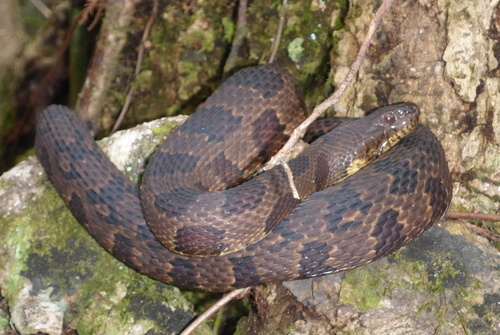
The brown water snake (Nerodia taxispilota) is a large species of nonvenomous natricine snake endemic to the southeastern United States. Dorsal scales are in 27–33 rows (more than any other North American water snake), and it has two to four anterior temporals (usually one in others).Wikipedia ↗
Habitat
Nerodia taxispilota is found in lower coastal regions from southeastern Virginia, through North Carolina, South Carolina, and Georgia, to northern and western Florida (Gulf Coast), then west through Alabama, and Mississippi, to Louisiana, normally from sea level to 500 ft. (150 m) elevation. Nerodia taxispilota is found in swamps and streams and is often mistaken for a moccasin.Wikipedia ↗
When it's active
Mating takes place in the spring on land or on tree branches. In this study, females ovulated in mid-summer (June), and young were at full-term by late August.Wikipedia ↗Animal Diversity Web ↗
Often mistaken for
When and where it's active
Each row is its own calendar, counted from records in that area. Seasons shift by place.
Ecoregions
States
About the Brown Watersnake
When is the Brown Watersnake most active?
Across the regions where it's common, the Brown Watersnake peaks from February to July.
Where does the Brown Watersnake live?
It has enough records to show in 5 ecoregions and 5 states, including Florida, Georgia, North Carolina, and South Carolina.
What does the Brown Watersnake look like?
It's often confused with the Northern Cottonmouth and Florida Cottonmouth.