Snakes
Common Watersnake
Nerodia sipedon
Across the regions where it's common, the Common Watersnake peaks from April to August.
Shows up in 17 ecoregions and 33 states
Keep Herp Calendar free
Hi, I'm Nick. I built Herp Calendar on my own and I keep it free, with no ads. If it has helped you find a herp this season, a small tip goes straight into the hosting and the data work. Only if you can spare it. Either way, I'm glad you're here.
Snakes
Common Watersnake
Nerodia sipedon
Description
The common watersnake (Nerodia sipedon) is a species of large, nonvenomous, common snake in the family Colubridae. The common watersnake can grow up to 135 cm (4 ft 5 in) in total length (including tail).Wikipedia ↗
Habitat
The northern watersnake (Nerodia s. sipedon) naturally occurs as far west as Colorado, east of the Rocky Mountains, and is commonly found in riparian ecosystems along river systems, such as the South Platte River and Arkansas River. N. sipedon inhabits streams, lakes, and ponds, as well as wetlands.Wikipedia ↗
When it's active
N. sipedon is active during the day and at night. Female movement during the mating period was directly and positively related to male mate location success and this effect was intensified when females were freshly-shed.Wikipedia ↗
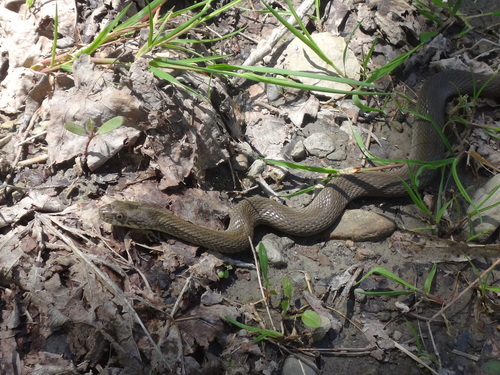
Often mistaken for
Often mistaken for
When and where it's active
Each row is its own calendar, counted from records in that area. Seasons shift by place.
Ecoregions
States
About the Common Watersnake
When is the Common Watersnake most active?
Across the regions where it's common, the Common Watersnake peaks from April to August.
Where does the Common Watersnake live?
It has enough records to show in 17 ecoregions and 33 states, including Alabama, Arkansas, Colorado, and Connecticut.
What does the Common Watersnake look like?
It's often confused with the Eastern Copperhead and Broad-banded Copperhead.
What does the Common Watersnake look like?
It's often confused with the Northern Cottonmouth and Florida Cottonmouth.