Snakes
Eastern Copperhead
Agkistrodon contortrix
Across the regions where it's common, the Eastern Copperhead peaks from April to October.
Shows up in 12 ecoregions and 23 states · venomous
Keep Herp Calendar free
Hi, I'm Nick. I built Herp Calendar on my own and I keep it free, with no ads. If it has helped you find a herp this season, a small tip goes straight into the hosting and the data work. Only if you can spare it. Either way, I'm glad you're here.
Snakes
Eastern Copperhead
Agkistrodon contortrix
Description
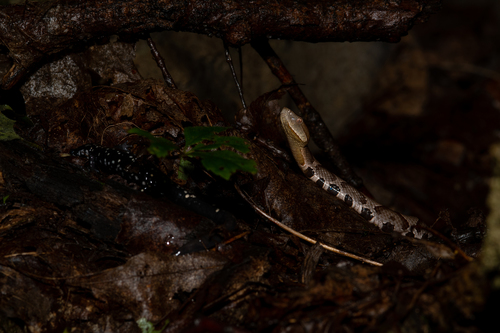
The eastern copperhead (Agkistrodon contortrix), also known simply as the copperhead, is a widespread species of venomous snake, a pit viper, endemic to eastern United States of America; it is a member of the subfamily Crotalinae in the family Viperidae. Adults grow to a typical length (including tail) of 50–95 cm (20–37 in).Wikipedia ↗
Habitat
Eastern copperheads are habitat generalists which are species able to survive in different habitats (fragmented and unfragmented). In the states around the Gulf of Mexico, however, this species is also found in coniferous forest.Wikipedia ↗
When it's active
In the Southern United States, copperheads are nocturnal during the hot summer, but are commonly active during the day during the spring and fall. Eastern copperheads breed in late summer, but not every year; sometimes, females produce young for several years running, then do not breed at all for a time.Wikipedia ↗
Venom
Copperhead venom has an estimated lethal dose around 100 mg, and tests on mice show its potency is among the lowest of all pit vipers, and slightly weaker than that of its close relative, the cottonmouth. The fangs of dead pit vipers are capable of delivering venom in amounts that necessitate the use of antivenom.Wikipedia ↗
Harmless look-alikes
When and where it's active
Each row is its own calendar, counted from records in that area. Seasons shift by place.
Ecoregions
States
About the Eastern Copperhead
When is the Eastern Copperhead most active?
Across the regions where it's common, the Eastern Copperhead peaks from April to October.
Where does the Eastern Copperhead live?
It has enough records to show in 12 ecoregions and 23 states, including Alabama, Arkansas, Connecticut, and Georgia.
Is the Eastern Copperhead venomous?
Yes. The Eastern Copperhead is venomous. Don't handle it, and give it room.
What snakes get mistaken for the Eastern Copperhead?
Harmless lookalikes include the Central Ratsnake, Western Ratsnake, and Red Cornsnake.