Snakes
Red Cornsnake
Pantherophis guttatus
Across the regions where it's common, the Red Cornsnake peaks from February to December.
Shows up in 2 ecoregions and 8 states
Keep Herp Calendar free
Hi, I'm Nick. I built Herp Calendar on my own and I keep it free, with no ads. If it has helped you find a herp this season, a small tip goes straight into the hosting and the data work. Only if you can spare it. Either way, I'm glad you're here.
Snakes
Red Cornsnake
Pantherophis guttatus
Description
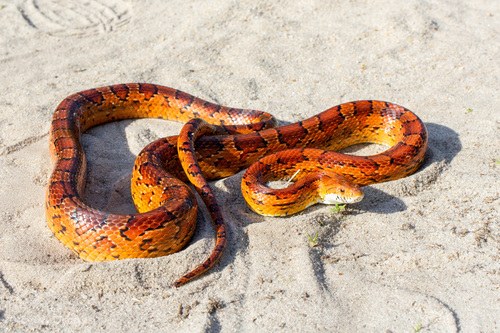
The corn snake (Pantherophis guttatus), sometimes called the Red Rat Snake is a species of North American rat snake in the family Colubridae. As an adult the corn snake may have a total length (including tail) of 61–182 cm (2.00–5.97 ft).Wikipedia ↗
Habitat
In the wild, the corn snake prefers habitats such as overgrown fields, forest openings, trees, palmetto flatwoods, and abandoned or seldom-used buildings and farms, from sea level to as high as 6,000 ft (1,800 m). The range of Great Plains rat snakes extends from southwestern Illinois through Texas and into northern Mexico, and as far west as eastern New Mexico.Wikipedia ↗Animal Diversity Web ↗
When it's active
Corn snakes are relatively easy to breed. Corn snakes brumate around 10 to 16 °C (50 to 61 °F) in a place where they cannot be disturbed and with little sunlight.Wikipedia ↗
Often mistaken for
When and where it's active
Each row is its own calendar, counted from records in that area. Seasons shift by place.
Ecoregions
States
About the Red Cornsnake
When is the Red Cornsnake most active?
Across the regions where it's common, the Red Cornsnake peaks from February to December.
Where does the Red Cornsnake live?
It has enough records to show in 2 ecoregions and 8 states, including Alabama, Florida, Georgia, and Mississippi.
What does the Red Cornsnake look like?
It's often confused with the Eastern Copperhead and Broad-banded Copperhead.