Snakes
Broad-banded Copperhead
Agkistrodon laticinctus
Across the regions where it's common, the Broad-banded Copperhead peaks from April to August.
Shows up in 6 ecoregions and 3 states · venomous
Keep Herp Calendar free
Hi, I'm Nick. I built Herp Calendar on my own and I keep it free, with no ads. If it has helped you find a herp this season, a small tip goes straight into the hosting and the data work. Only if you can spare it. Either way, I'm glad you're here.
Snakes
Broad-banded Copperhead
Agkistrodon laticinctus
Description
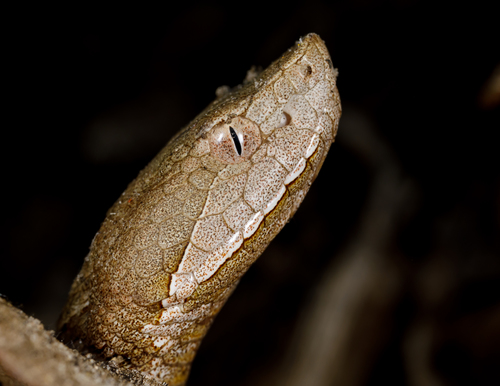
Agkistrodon laticinctus, commonly known as the broad-banded copperhead, is a venomous pit viper species, formerly considered a subspecies of Agkistrodon contortrix, which is found in the central United States, from Kansas, through Oklahoma and throughout central Texas. The actual color varies, by locality, from a red-brown, to a gray-brown.Wikipedia ↗
Habitat
The broad-banded copperhead (A. laticinctus) is endemic to North America, where it occurs in the South Central states of Oklahoma and Texas in the USA, and the adjacent margins of the Mexican states of Chihuahua and Coahuila. It ranges from north-central Oklahoma, south to the Edwards Plateau in Texas, and west into southern counties of the Trans-Pecos region of Texas, including Brewster, Jeff Davis, Pecos, Presidio, and Terrell counties.Wikipedia ↗
When it's active
They are ovoviviparous, giving birth to a litter of up to eight young in the early fall.Wikipedia ↗
Venom
Like most pit viper species, A. laticinctus has a hemotoxic venom, which is delivered through hinged, hollow fangs set in the front of their jaws. Copperhead venom is not considered to be life-threatening to an otherwise healthy adult, but it can cause localized swelling, necrosis, and severe pain.Wikipedia ↗
Harmless look-alikes
When and where it's active
Each row is its own calendar, counted from records in that area. Seasons shift by place.
Ecoregions
States
About the Broad-banded Copperhead
When is the Broad-banded Copperhead most active?
Across the regions where it's common, the Broad-banded Copperhead peaks from April to August.
Where does the Broad-banded Copperhead live?
It has enough records to show in 6 ecoregions and 3 states, including Kansas, Oklahoma, and Texas.
Is the Broad-banded Copperhead venomous?
Yes. The Broad-banded Copperhead is venomous. Don't handle it, and give it room.
What snakes get mistaken for the Broad-banded Copperhead?
Harmless lookalikes include the Central Ratsnake, Western Ratsnake, and Red Cornsnake.