Snakes
Banded Watersnake
Nerodia fasciata
Across the regions where it's common, the Banded Watersnake peaks from January to September.
Shows up in 6 ecoregions and 10 states
Keep Herp Calendar free
Hi, I'm Nick. I built Herp Calendar on my own and I keep it free, with no ads. If it has helped you find a herp this season, a small tip goes straight into the hosting and the data work. Only if you can spare it. Either way, I'm glad you're here.
Snakes
Banded Watersnake
Nerodia fasciata
Description
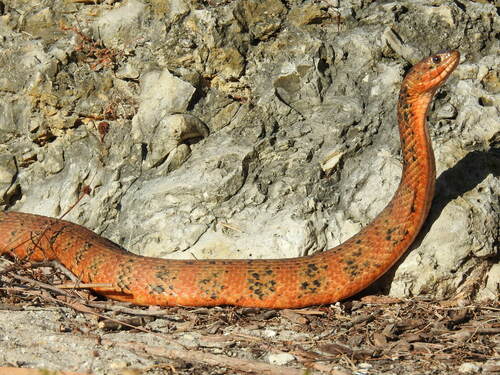
The banded water snake or southern water snake (Nerodia fasciata) is a species of mostly aquatic, nonvenomous, colubrid snakes most commonly found in the Midwest, Southeastern United States. Adults of the banded water snake typically range from 56 to 107 cm (22 to 42 in) in total length, with a record size (in the Florida subspecies) of 159 cm (62.5 in) in total length.Wikipedia ↗
Habitat
Introduced populations exist in Texas and California; other sources include eastern Texas in its natural range. Nerodia fasciata inhabits most freshwater environments such as lakes, marshes, ponds, and streams.Wikipedia ↗
When it's active
A female will start ovulating from early May to mid-June after awakening from a period of hibernation. Males produce sperm in the fall that will be ready for summer mating.Animal Diversity Web ↗
Often mistaken for
When and where it's active
Each row is its own calendar, counted from records in that area. Seasons shift by place.
Ecoregions
States
About the Banded Watersnake
When is the Banded Watersnake most active?
Across the regions where it's common, the Banded Watersnake peaks from January to September.
Where does the Banded Watersnake live?
It has enough records to show in 6 ecoregions and 10 states, including Alabama, Arkansas, Florida, and Georgia.
What does the Banded Watersnake look like?
It's often confused with the Northern Cottonmouth and Florida Cottonmouth.