Lizards
Western Skink
Plestiodon skiltonianus
Across the regions where it's common, the Western Skink peaks from February to May.
Shows up in 10 ecoregions and 5 states
Keep Herp Calendar free
Hi, I'm Nick. I built Herp Calendar on my own and I keep it free, with no ads. If it has helped you find a herp this season, a small tip goes straight into the hosting and the data work. Only if you can spare it. Either way, I'm glad you're here.
Lizards
Western Skink
Plestiodon skiltonianus
Description
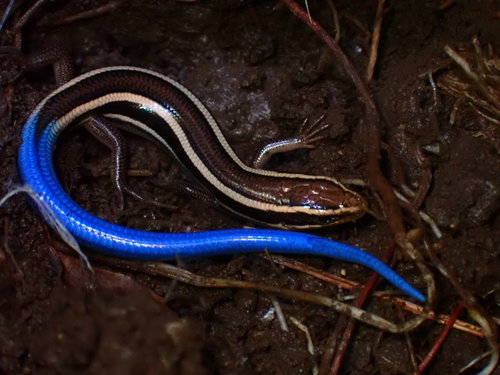
The western skink (Plestiodon skiltonianus) is a species of small, smooth-scaled lizard with relatively small limbs. Juvenile skink's tails are bright blue, turning to grey in adulthood.Wikipedia ↗
Habitat
Found in a variety of habitats from sea level to at least 2,130 m (7,000 ft), the western skink is commonest in early successional stages or open areas within habitats in which it occurs. The western skink seems to prefer a somewhat moist environment, although it can also be found on dry hillsides.Wikipedia ↗
When it's active
During summer most activity is concentrated in the morning and late afternoon. Where summer temperatures are not extreme, activity extends throughout the day.Wikipedia ↗
When and where it's active
Each row is its own calendar, counted from records in that area. Seasons shift by place.
Ecoregions
States
About the Western Skink
When is the Western Skink most active?
Across the regions where it's common, the Western Skink peaks from February to May.
Where does the Western Skink live?
It has enough records to show in 10 ecoregions and 5 states, including California, Idaho, Oregon, and Utah.