Snakes
Western Diamond-backed Rattlesnake
Crotalus atrox
Across the regions where it's common, the Western Diamond-backed Rattlesnake peaks from March to October.
Shows up in 12 ecoregions and 5 states · venomous
Keep Herp Calendar free
Hi, I'm Nick. I built Herp Calendar on my own and I keep it free, with no ads. If it has helped you find a herp this season, a small tip goes straight into the hosting and the data work. Only if you can spare it. Either way, I'm glad you're here.
Snakes
Western Diamond-backed Rattlesnake
Crotalus atrox
Description
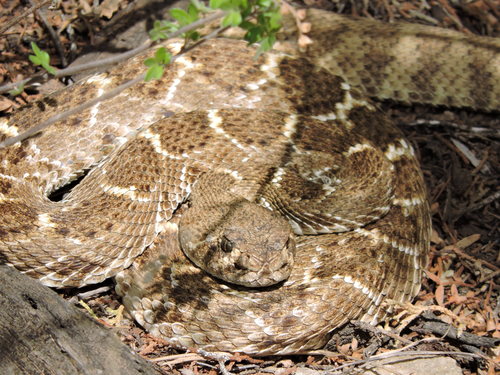
The western diamondback rattlesnake (Crotalus atrox) or western diamond-backed rattlesnake, is a rattlesnake species and member of the viper family, found in the southwestern United States and Mexico. Adults commonly grow to 120 cm (4 ft) in length.Wikipedia ↗
Habitat
It is found in the United States from central Arkansas to southeastern and Central California, south into Mexico as far as northern Sinaloa, Hidalgo and northern Veracruz. Its habitats range from flat coastal plains to steep rocky canyons and hillsides; it is associated with many different vegetation types, including desert, sandy creosote areas, mesquite grassland, desert scrub, and pine-oak forests.Wikipedia ↗
When it's active
C. atrox is solitary except during the mating season, when males of the species are single-minded and aggressive in pursuing females. Active, alert, and large (most adults are between four and a half and five feet long), the western diamondback can administer a large amount of venom in its bite; it is not inclined to give ground when confronted.Wikipedia ↗
Venom
Like that of most other American pit vipers, the venom contains proteolytic enzymes. Proteolytic venoms are concentrated secretions that destroy structural tissues and proteins via catabolism, which help in disabling prey.Wikipedia ↗
Harmless look-alikes
When and where it's active
Each row is its own calendar, counted from records in that area. Seasons shift by place.
Ecoregions
States
About the Western Diamond-backed Rattlesnake
When is the Western Diamond-backed Rattlesnake most active?
Across the regions where it's common, the Western Diamond-backed Rattlesnake peaks from March to October.
Where does the Western Diamond-backed Rattlesnake live?
It has enough records to show in 12 ecoregions and 5 states, including Arizona, California, New Mexico, and Oklahoma.
Is the Western Diamond-backed Rattlesnake venomous?
Yes. The Western Diamond-backed Rattlesnake is venomous. Don't handle it, and give it room.
What snakes get mistaken for the Western Diamond-backed Rattlesnake?
Harmless lookalikes include the Gopher Snake, Pine Snake, and Eastern Hognose Snake.