← Herp Calendar map
Lizards
Desert Night Lizard
Xantusia vigilis
Across the regions where it's common, the Desert Night Lizard peaks from January to October.
Shows up in 1 ecoregion and 1 state
Keep Herp Calendar free
Hi, I'm Nick. I built Herp Calendar on my own and I keep it free, with no ads. If it has helped you find a herp this season, a small tip goes straight into the hosting and the data work. Only if you can spare it. Either way, I'm glad you're here.
Lizards
Desert Night Lizard
Xantusia vigilis
Look, don't take. Many states regulate collecting reptiles and amphibians. Photograph it, log it on iNaturalist and leave it where you found it.
Description
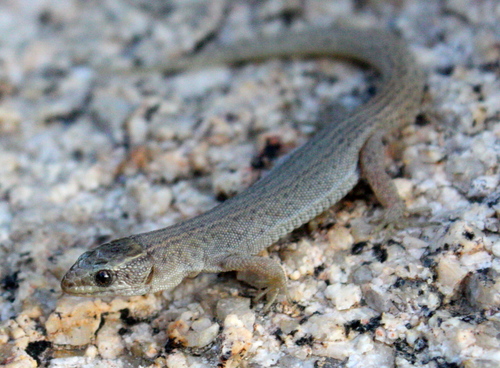
The desert night lizard (Xantusia vigilis) is a night lizard native to the Southern California Eastern Sierra and the San Gabriel Mountains into Baja California, southern Nevada, southwestern Utah and extreme western areas of Arizona. The desert night lizard attains a snout-to-vent length (SVL) of 1.5 to 2.75 in (3.8 to 7.0 cm) with a tail roughly the same length.Wikipedia ↗
Habitat
Smaller populations of X. vigilis have been found in western Arizona, central California coastal ranges, Colorado, the Sierra Nevada, and Utah. Like most members of genus Xantusia, "X. vigilis" lives in arid and semi-arid habitats.Wikipedia ↗
When it's active
Winter groups (aggregates formed to survive through the cold winter) proved advantageous, allowing for greater internal heat retention for individual lizards and for the collective group as a whole. Most winter groups are as large as 20 lizards.Wikipedia ↗
When and where it's active
Each row is its own calendar, counted from records in that area. Seasons shift by place.
PeakShoulderQuiet
Ecoregions
JanFebMarAprMayJunJulAugSepOctNovDec
Mojave DesertStates
JanFebMarAprMayJunJulAugSepOctNovDec
CaliforniaAbout the Desert Night Lizard
When is the Desert Night Lizard most active?
Across the regions where it's common, the Desert Night Lizard peaks from January to October.
Where does the Desert Night Lizard live?
It has enough records to show in 1 ecoregions and 1 states, including California.