Turtles
Florida Red-bellied Cooter
Pseudemys nelsoni
Across the regions where it's common, the Florida Red-bellied Cooter peaks from November to May.
Shows up in 1 ecoregion and 2 states
Keep Herp Calendar free
Hi, I'm Nick. I built Herp Calendar on my own and I keep it free, with no ads. If it has helped you find a herp this season, a small tip goes straight into the hosting and the data work. Only if you can spare it. Either way, I'm glad you're here.
Turtles
Florida Red-bellied Cooter
Pseudemys nelsoni
Description
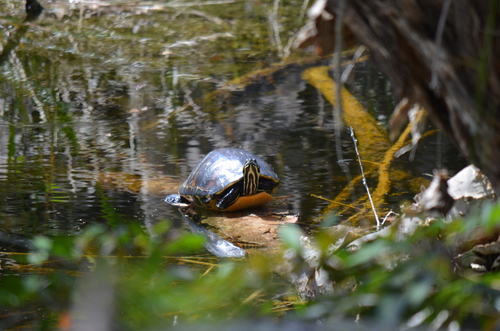
The Florida red-bellied cooter or Florida redbelly turtle (Pseudemys nelsoni) is a species of turtle in the family Emydidae. The Florida red-bellied cooter can be distinguished from other similar turtles by its distinctive red-tinged plastron (belly) and two cusps (like teeth) on its upper beak.Wikipedia ↗
Habitat
Pseudemys nelsoni is native to Florida, and southern Georgia. Fossils of P. nelsoni have also been found along the coast of South Carolina from the Pleistocene Epoch, indicating that the historic range of this species used to extend farther north.Wikipedia ↗
When it's active
Mating begins with the males approaching the females. Their breeding season is primarily from April to July when the water temperature is warmer.Animal Diversity Web ↗
When and where it's active
Each row is its own calendar, counted from records in that area. Seasons shift by place.
Ecoregions
States
About the Florida Red-bellied Cooter
When is the Florida Red-bellied Cooter most active?
Across the regions where it's common, the Florida Red-bellied Cooter peaks from November to May.
Where does the Florida Red-bellied Cooter live?
It has enough records to show in 1 ecoregions and 2 states, including Florida and Texas.