Salamanders
Red-cheeked Salamander
Plethodon jordani
Across the regions where it's common, the Red-cheeked Salamander peaks from April to September.
Shows up in 1 ecoregion and 2 states
Keep Herp Calendar free
Hi, I'm Nick. I built Herp Calendar on my own and I keep it free, with no ads. If it has helped you find a herp this season, a small tip goes straight into the hosting and the data work. Only if you can spare it. Either way, I'm glad you're here.
Salamanders
Red-cheeked Salamander
Plethodon jordani
Description
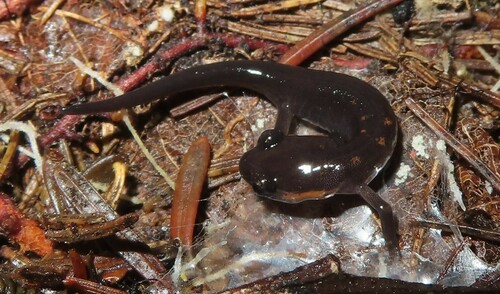
The red-cheeked salamander (Plethodon jordani), also known as the Jordan's salamander, Jordan's redcheek salamander, or Appalachian woodland salamander, is a species of salamander in the family Plethodontidae. The red-cheeked salamander is a uniform steely grey colour with conspicuous red, orange or yellow patches on the side of the head.Wikipedia ↗
Habitat
The red-cheeked salamander is found in mountainous areas of the southeastern United States. The main populations are along the border between North Carolina and Tennessee, but separate populations occur in Rabun County, Georgia.Wikipedia ↗
When it's active
Females may court several times and mate with two or more males in one season. Males will often attempt to mate other males and mimic the behaviors of a female.Animal Diversity Web ↗
When and where it's active
Each row is its own calendar, counted from records in that area. Seasons shift by place.
Ecoregions
States
About the Red-cheeked Salamander
When is the Red-cheeked Salamander most active?
Across the regions where it's common, the Red-cheeked Salamander peaks from April to September.
Where does the Red-cheeked Salamander live?
It has enough records to show in 1 ecoregions and 2 states, including North Carolina and Tennessee.