Lizards
Madagascar Giant Day Gecko
Phelsuma grandis
Across the regions where it's common, the Madagascar Giant Day Gecko peaks from April to September.
Shows up in 2 ecoregions and 2 states
Keep Herp Calendar free
Hi, I'm Nick. I built Herp Calendar on my own and I keep it free, with no ads. If it has helped you find a herp this season, a small tip goes straight into the hosting and the data work. Only if you can spare it. Either way, I'm glad you're here.
Lizards
Madagascar Giant Day Gecko
Phelsuma grandis
Description
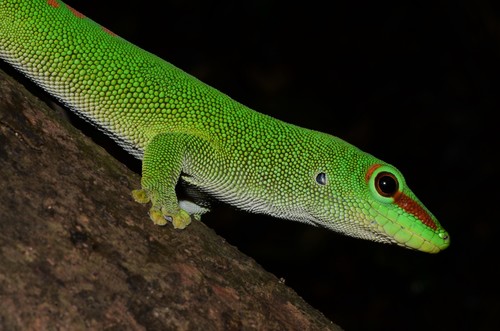
Phelsuma grandis is a diurnal arboreal species of day gecko. This lizard reaches a total length of 9–11″ (23–28cm), with females generally being smaller than males.Wikipedia ↗
Habitat
This species is widely distributed in northern and northwest Madagascar. Day Geckos specifically encroach on the habitats of Phelsuma cepediana, blue-tailed day gecko; Phelsuma guimbeaui, lowland forest day gecko; Phelsuma ornata, ornate day gecko; Phelsuma rosagularis, upland forest day gecko in Mauritius.Wikipedia ↗
When it's active
Breeding behavior includes, the shaking of the tail or body, vocalizing, and if the female does not accept the male she may turn a darker green. The breeding season is between December and June.Wikipedia ↗
When and where it's active
Each row is its own calendar, counted from records in that area. Seasons shift by place.
Ecoregions
States
About the Madagascar Giant Day Gecko
When is the Madagascar Giant Day Gecko most active?
Across the regions where it's common, the Madagascar Giant Day Gecko peaks from April to September.
Where does the Madagascar Giant Day Gecko live?
It has enough records to show in 2 ecoregions and 2 states, including Florida and Hawaii.