← Herp Calendar map
Frogs and Toads
Sheep Frog
Hypopachus variolosus
Across the regions where it's common, the Sheep Frog peaks from May to August.
Shows up in 2 ecoregions and 1 state
Keep Herp Calendar free
Hi, I'm Nick. I built Herp Calendar on my own and I keep it free, with no ads. If it has helped you find a herp this season, a small tip goes straight into the hosting and the data work. Only if you can spare it. Either way, I'm glad you're here.
Frogs and Toads
Sheep Frog
Hypopachus variolosus
Look, don't take. Many states regulate collecting reptiles and amphibians. Photograph it, log it on iNaturalist and leave it where you found it.
Description
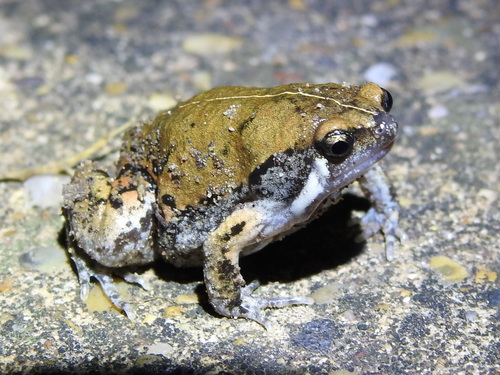
The northern sheep frog (Hypopachus variolosus) is native to Central America, Mexico, and extreme south Texas, United States. The sheep frog is a relatively small frog, 2.5-3.8 cm, with rare individuals exceeding 4 cm.Wikipedia ↗
Habitat
The sheep frog ranges through parts of Central America and Mexico, generally in lower elevation coastal areas below 1600 m, reaching its northernmost limit in far south Texas, US. Several areas within the range, such as southern Belize and northern Sinaloa lack records, suggesting possible gaps in the distribution.Wikipedia ↗
When it's active
It emerges after heavy rains to breed and occasionally forage at night, and may be found under rocks, logs and fallen palm trees, and other surface debris while soils remain wet. Emergence and mating is typically stimulated by heavy rain, or on occasions the irrigation of fields.Wikipedia ↗
When and where it's active
Each row is its own calendar, counted from records in that area. Seasons shift by place.
PeakShoulderQuiet
Ecoregions
States
JanFebMarAprMayJunJulAugSepOctNovDec
TexasAbout the Sheep Frog
When is the Sheep Frog most active?
Across the regions where it's common, the Sheep Frog peaks from May to August.
Where does the Sheep Frog live?
It has enough records to show in 2 ecoregions and 1 states, including Texas.