Salamanders
Cave Salamander
Eurycea lucifuga
Across the regions where it's common, the Cave Salamander peaks from October to July.
Shows up in 4 ecoregions and 10 states
Keep Herp Calendar free
Hi, I'm Nick. I built Herp Calendar on my own and I keep it free, with no ads. If it has helped you find a herp this season, a small tip goes straight into the hosting and the data work. Only if you can spare it. Either way, I'm glad you're here.
Salamanders
Cave Salamander
Eurycea lucifuga
Description
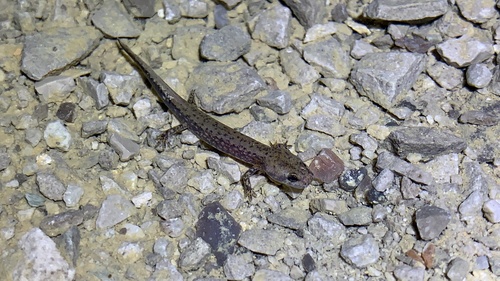
The cave salamander or spotted-tail salamander (Eurycea lucifuga) is a species of brook salamander in the family Plethodontidae. The cave salamander is a relatively large lungless salamander, ranging in total length from 10 to 20 cm (4 to 8 in).Wikipedia ↗
Habitat
Cave salamanders are typically found in areas with exposed limestone or other calcareous rock, particularly in crevices of rock faces, bluffs and caves. This species is found in Alabama, Arkansas Illinois, Missouri, Kentucky, Virginia, West Virginia, Oklahoma, Tennessee, Kansas, Indiana, and Ohio.Wikipedia ↗
When it's active
The courtship and mating season is not well documented in this species, although available data suggests it occurs in the summer, continuing to early autumn. Larval cave salamanders appear similar to other larval Eurycea.Wikipedia ↗
When and where it's active
Each row is its own calendar, counted from records in that area. Seasons shift by place.
Ecoregions
States
About the Cave Salamander
When is the Cave Salamander most active?
Across the regions where it's common, the Cave Salamander peaks from October to July.
Where does the Cave Salamander live?
It has enough records to show in 4 ecoregions and 10 states, including Alabama, Arkansas, Georgia, and Illinois.