Salamanders
Blue Ridge Blackbelly Salamander
Desmognathus mavrokoilius
Across the regions where it's common, the Blue Ridge Blackbelly Salamander peaks from February to March.
Shows up in 1 ecoregion and 2 states
Keep Herp Calendar free
Hi, I'm Nick. I built Herp Calendar on my own and I keep it free, with no ads. If it has helped you find a herp this season, a small tip goes straight into the hosting and the data work. Only if you can spare it. Either way, I'm glad you're here.
Salamanders
Blue Ridge Blackbelly Salamander
Desmognathus mavrokoilius
Description
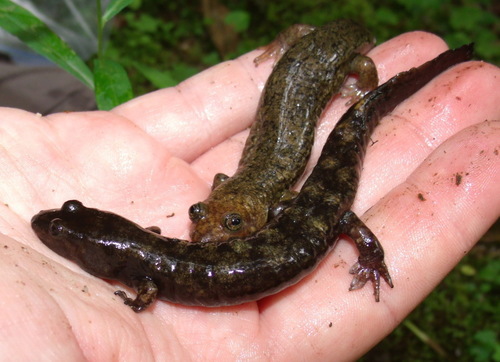
The Pisgah black-bellied salamander or Blue Ridge black-bellied salamander (Desmognathus mavrokoilius) is a species of lungless salamander in the family Plethodontidae.Wikipedia ↗
Habitat
It is endemic to the eastern United States, where it is only known from the southern Appalachian Mountains. It ranges throughout the Blue Ridge Mountains of much of western North Carolina and eastern Tennessee north to extreme southwest Virginia, being bordered to the south by the eastern Great Smoky Mountains and southeastern Great Balsams, and to the north by Mount Rogers.Wikipedia ↗
When and where it's active
Each row is its own calendar, counted from records in that area. Seasons shift by place.
Ecoregions
States
About the Blue Ridge Blackbelly Salamander
When is the Blue Ridge Blackbelly Salamander most active?
Across the regions where it's common, the Blue Ridge Blackbelly Salamander peaks from February to March.
Where does the Blue Ridge Blackbelly Salamander live?
It has enough records to show in 1 ecoregions and 2 states, including North Carolina and Tennessee.