Snakes
Tiger Rattlesnake
Crotalus tigris
Across the regions where it's common, the Tiger Rattlesnake peaks from July to September.
Shows up in 2 ecoregions and 1 state · venomous
Keep Herp Calendar free
Hi, I'm Nick. I built Herp Calendar on my own and I keep it free, with no ads. If it has helped you find a herp this season, a small tip goes straight into the hosting and the data work. Only if you can spare it. Either way, I'm glad you're here.
Snakes
Tiger Rattlesnake
Crotalus tigris
Description
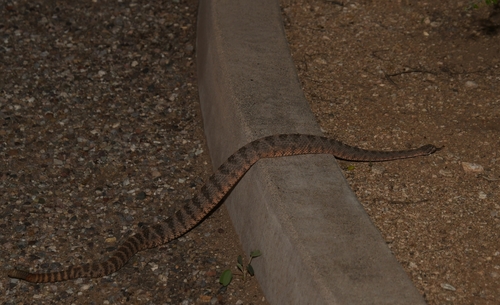
The tiger rattlesnake (Crotalus tigris) is a highly venomous pit viper species found in the southwestern United States and northwestern Mexico. The color pattern consists of a gray, lavender, blue-gray, pink, or buff ground color that usually turns to pink, pale orange, or cream on the sides.Wikipedia ↗
Habitat
The species' range extends from central Arizona south through south-central Arizona in the United States, to southern Sonora, Mexico, including Isla Tiburón in the Gulf of California and was recently discovered in the southern Peloncillo Mountains of Arizona. Tiger rattlesnakes habitats include rocky desert canyons, foothills, and bajadas, in vegetation zones ranging from thornscrub, ocotillo-mesquite-creosote bush, saguaro-paloverde, mesquite grassland, and chaparral to tropical deciduous forest (southern Sonora) and the lower edge of oak woodland.Wikipedia ↗
When it's active
Tiger rattlesnakes are terrestrial snakes and are nocturnal during the hot summer (June–August), but become diurnal and crepuscular during the fall season. They hibernate during the late fall and winter in rock crevices or animal burrows.Wikipedia ↗
Venom
Brown (1973) lists an average venom yield of 11 mg (dried venom) and an LD50 value of 0.6 mg/kg IP for toxicity. Minton and Weinstein (1984) list an average venom yield of 6.4 mg (based on two specimens).Wikipedia ↗
Harmless look-alikes
When and where it's active
Each row is its own calendar, counted from records in that area. Seasons shift by place.
Ecoregions
States
About the Tiger Rattlesnake
When is the Tiger Rattlesnake most active?
Across the regions where it's common, the Tiger Rattlesnake peaks from July to September.
Where does the Tiger Rattlesnake live?
It has enough records to show in 2 ecoregions and 1 states, including Arizona.
Is the Tiger Rattlesnake venomous?
Yes. The Tiger Rattlesnake is venomous. Don't handle it, and give it room.
What snakes get mistaken for the Tiger Rattlesnake?
Harmless lookalikes include the Gopher Snake, Pine Snake, and Eastern Hognose Snake.