Snakes
Eastern Diamondback Rattlesnake
Crotalus adamanteus
Across the regions where it's common, the Eastern Diamondback Rattlesnake peaks from August to March.
Shows up in 1 ecoregion and 4 states · venomous
Keep Herp Calendar free
Hi, I'm Nick. I built Herp Calendar on my own and I keep it free, with no ads. If it has helped you find a herp this season, a small tip goes straight into the hosting and the data work. Only if you can spare it. Either way, I'm glad you're here.
Snakes
Eastern Diamondback Rattlesnake
Crotalus adamanteus
Description
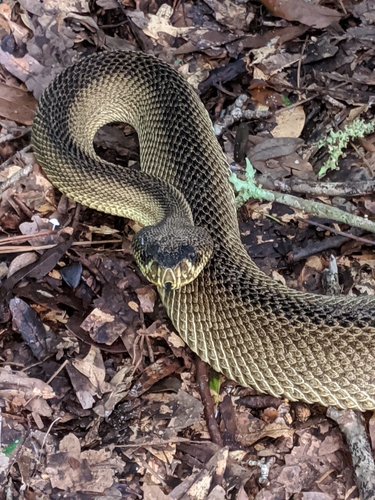
The eastern diamondback rattlesnake (Crotalus adamanteus) is a species of pit viper in the family Viperidae. The eastern diamondback rattlesnake is the largest rattlesnake species and is one of the heaviest known species of venomous snake, with one specimen shot in 1946 measuring 2.4 m (7.8 ft) in length and weighing 15.4 kg (34 lb).Wikipedia ↗
Habitat
The eastern diamondback rattlesnake is found in the Southeastern United States from southeastern North Carolina, south along the coastal plain through peninsular Florida to the Florida Keys, and west along the Gulf Coast through southern Alabama and Mississippi to southeastern Louisiana. The species is endemic to the Southeastern United States.Wikipedia ↗
When it's active
Eastern diamondbacks mate from early August through September in the northern part of their range, and from early October through December in the southernmost part of their range (mainly southern Florida). Males will travel long distances in search of mates during the breeding season, tracking the females by their pheromone trails.Animal Diversity Web ↗
Venom
The eastern diamondback rattlesnake has the reputation of being the most dangerous venomous snake in North America. Brown gives an average venom yield of 410 mg (dried venom), along with LD50 values of 1.3–2.4 mg/kg IV, 1.7–3.0 mg/kg IP and 10-14.5 mg/kg SC for toxicity.Wikipedia ↗
Harmless look-alikes
When and where it's active
Each row is its own calendar, counted from records in that area. Seasons shift by place.
Ecoregions
States
About the Eastern Diamondback Rattlesnake
When is the Eastern Diamondback Rattlesnake most active?
Across the regions where it's common, the Eastern Diamondback Rattlesnake peaks from August to March.
Where does the Eastern Diamondback Rattlesnake live?
It has enough records to show in 1 ecoregions and 4 states, including Alabama, Florida, Georgia, and Mississippi.
Is the Eastern Diamondback Rattlesnake venomous?
Yes. The Eastern Diamondback Rattlesnake is venomous. Don't handle it, and give it room.
What snakes get mistaken for the Eastern Diamondback Rattlesnake?
Harmless lookalikes include the Gopher Snake, Pine Snake, and Eastern Hognose Snake.