Lizards
Western Banded Gecko
Coleonyx variegatus
Across the regions where it's common, the Western Banded Gecko peaks from March to October.
Shows up in 4 ecoregions and 4 states
Keep Herp Calendar free
Hi, I'm Nick. I built Herp Calendar on my own and I keep it free, with no ads. If it has helped you find a herp this season, a small tip goes straight into the hosting and the data work. Only if you can spare it. Either way, I'm glad you're here.
Lizards
Western Banded Gecko
Coleonyx variegatus
Description
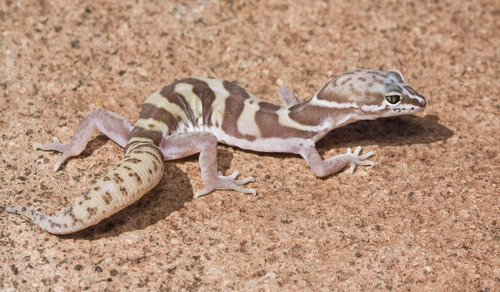
The western banded gecko (Coleonyx variegatus) is a species of lizard in the family Eublepharidae. The western banded gecko is a terrestrial lizard, ranging in total length (including tail) from 4–6 inches (10–15 cm).Wikipedia ↗
Habitat
In the United States, C. variegatus is found in Arizona, southern California, southwestern New Mexico, Nevada, and Utah. The western banded gecko is found in a wide range of habitats, including creosote bush and sagebrush desert, pinyon-juniper woodland, and catclaw-cedar-grama grass associations in the eastern part of its range and chaparral areas in the west.Wikipedia ↗
When it's active
The western banded gecko is secretive and nocturnal, with individuals remaining hidden during the day and emerging after sunset to forage for food. The Western banded geckos breed during the months April and May.Wikipedia ↗
When and where it's active
Each row is its own calendar, counted from records in that area. Seasons shift by place.
Ecoregions
States
About the Western Banded Gecko
When is the Western Banded Gecko most active?
Across the regions where it's common, the Western Banded Gecko peaks from March to October.
Where does the Western Banded Gecko live?
It has enough records to show in 4 ecoregions and 4 states, including Arizona, California, Nevada, and Utah.