← Herp Calendar map
Snakes
Trans-pecos Ratsnake
Bogertophis subocularis
Across the regions where it's common, the Trans-pecos Ratsnake peaks from May to July.
Shows up in 1 ecoregion and 1 state
Keep Herp Calendar free
Hi, I'm Nick. I built Herp Calendar on my own and I keep it free, with no ads. If it has helped you find a herp this season, a small tip goes straight into the hosting and the data work. Only if you can spare it. Either way, I'm glad you're here.
Snakes
Trans-pecos Ratsnake
Bogertophis subocularis
Look, don't take. Many states regulate collecting reptiles and amphibians. Photograph it, log it on iNaturalist and leave it where you found it.
Description
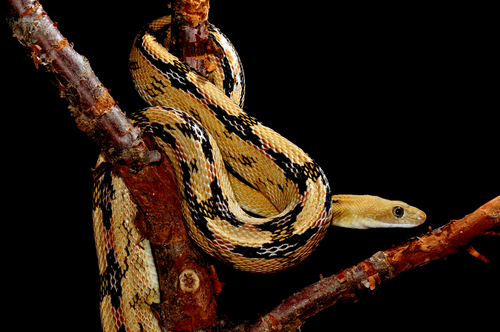
The Trans-Pecos rat snake or Davis Mountain rat snake (Bogertophis subocularis), is a species of medium to large, nonvenomous rat snake in the family Colubridae. Coloration is yellow to tan dorsally with a series of black, or dark brown, H-shaped markings.Wikipedia ↗
Habitat
The Trans-Pecos rat snake is found in the Mexican states of Chihuahua, Coahuila, Durango, and Nuevo León, and its range extends northward into Texas and New Mexico in the United States. The Trans-Pecos rat snake's habitat consists of desert flats and brushy slopes, and rocky outcrops where it dens.Wikipedia ↗
When it's active
A nocturnal species, B. subocularis is uncommon and rarely seen in the wild, save on warm summer nights during the breeding season. The breeding season for B. subocularis runs through May and June, while egg-laying begins in July and ends by September.Wikipedia ↗
When and where it's active
Each row is its own calendar, counted from records in that area. Seasons shift by place.
PeakShoulderQuiet
Ecoregions
JanFebMarAprMayJunJulAugSepOctNovDec
Chihuahuan DesertStates
JanFebMarAprMayJunJulAugSepOctNovDec
TexasAbout the Trans-pecos Ratsnake
When is the Trans-pecos Ratsnake most active?
Across the regions where it's common, the Trans-pecos Ratsnake peaks from May to July.
Where does the Trans-pecos Ratsnake live?
It has enough records to show in 1 ecoregions and 1 states, including Texas.