Salamanders
Western Tiger Salamander
Ambystoma mavortium
Across the regions where it's common, the Western Tiger Salamander peaks from April to October.
Shows up in 8 ecoregions and 10 states
Keep Herp Calendar free
Hi, I'm Nick. I built Herp Calendar on my own and I keep it free, with no ads. If it has helped you find a herp this season, a small tip goes straight into the hosting and the data work. Only if you can spare it. Either way, I'm glad you're here.
Salamanders
Western Tiger Salamander
Ambystoma mavortium
Description
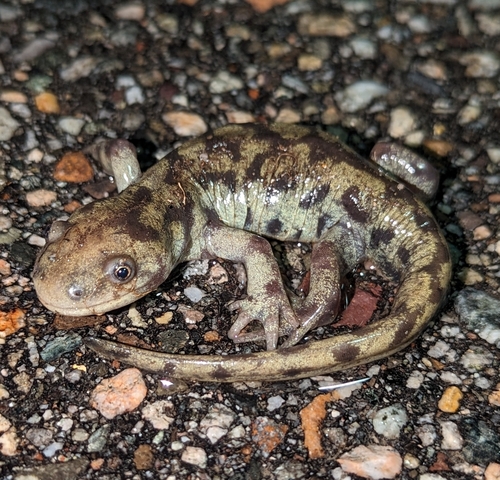
The barred tiger salamander or western tiger salamander (Ambystoma mavortium) is a species of mole salamander that lives in lower western Canada, the western United States and northern Mexico. The barred tiger salamander typically grows from 7.6 to 16.5 cm (3.0 to 6.5 in), but neotenic forms can grow to lengths of 17.8 to 38.1 cm (7.0 to 15.0 in).Wikipedia ↗
Habitat
Barred tiger salamanders primarily live in western Canada and the western half of the United States, but can be infrequently found in California and Nevada. It also inhabits open fields, rough ground, upland meadows, grasslands, deserts, semideserts and streams.Wikipedia ↗
When it's active
Primarily nocturnal, barred tiger salamanders are opportunistic feeders, and will often eat anything they can catch, including various insects, slugs, and earthworms. Breeding takes place during most months of the year.Wikipedia ↗
When and where it's active
Each row is its own calendar, counted from records in that area. Seasons shift by place.
Ecoregions
States
About the Western Tiger Salamander
When is the Western Tiger Salamander most active?
Across the regions where it's common, the Western Tiger Salamander peaks from April to October.
Where does the Western Tiger Salamander live?
It has enough records to show in 8 ecoregions and 10 states, including Colorado, Idaho, Kansas, and Montana.