← Herp Calendar map
Salamanders
Blue-spotted Salamander
Ambystoma laterale
Across the regions where it's common, the Blue-spotted Salamander peaks from March to May.
Shows up in 1 ecoregion and 6 states
Keep Herp Calendar free
Hi, I'm Nick. I built Herp Calendar on my own and I keep it free, with no ads. If it has helped you find a herp this season, a small tip goes straight into the hosting and the data work. Only if you can spare it. Either way, I'm glad you're here.
Salamanders
Blue-spotted Salamander
Ambystoma laterale
Look, don't take. Many states regulate collecting reptiles and amphibians. Photograph it, log it on iNaturalist and leave it where you found it.
Description
The blue-spotted salamander (Ambystoma laterale) is a mole salamander native to the Great Lakes states and northeastern United States, and parts of Ontario and Quebec in Canada. Blue-spotted salamanders are between 10 and 14 cm (3.9 and 5.5 in) in length, of which the tail comprises 40%.Wikipedia ↗
Habitat
Blue-spotted salamanders can be found in the northeastern parts of North America. Blue-spotted salamanders are primarily found in moist, deciduous hardwood forests and swampy woodlands with sandy soil, though they can be found in coniferous forests and fields too.Wikipedia ↗
When it's active
Blue-spotted salamanders mate through the depositing and collecting of a spermatophore. Eggs are laid in small agglomerations attached to twigs, rocks or plants at the edge of a woodland pond or ditch.Wikipedia ↗
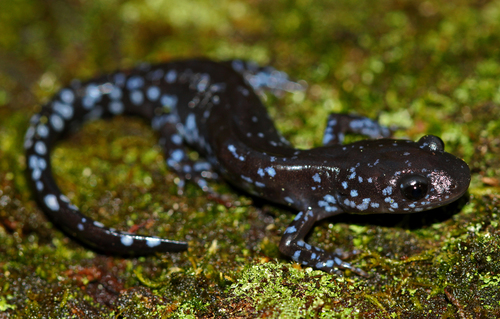
About the Blue-spotted Salamander
When is the Blue-spotted Salamander most active?
Across the regions where it's common, the Blue-spotted Salamander peaks from March to May.
Where does the Blue-spotted Salamander live?
It has enough records to show in 1 ecoregions and 6 states, including Maine, Michigan, Minnesota, and New York.